Episode notes
Why loading ships took days before the standard box
Before containerization, most general cargo arrived at the waterfront as separate sacks, barrels, crates, coils, bundles, and machines. A truckload did not remain a truckload. Workers unloaded it, sorted it in a transit shed, moved it to the ship, and then built it into the hold piece by piece. At the destination, the sequence ran in reverse.
The Historic American Engineering Record for American Racer describes conventional port turnarounds of a week as common and estimates that moving one ton of cargo could demand roughly 18 to 20 man-hours. The important delay was not necessarily at sea. It was the repeated change of custody and shape at the dock. Cargo crossed an ocean in one vessel but crossed the waterfront as hundreds or thousands of individual decisions.
What Malcom McLean changed was the transfer
Malcom McLean approached the problem from trucking, not naval architecture. His decisive question was whether the load could stay sealed while the vehicle beneath it changed. On 26 April 1956, the converted tanker Ideal X left Port Newark for Houston carrying 58 containers. The event mattered because the cargo had become a transferable unit before it reached the ship.
That change reduced handling, but it created a new dependency. A box that remains closed is useful only when cranes can lift it, chassis can carry it, ships can secure it, and another terminal can receive it. McLean’s method therefore needed more than a clever container. It needed agreement at every handoff. Containerization became powerful when the box stopped belonging to one trip and started fitting a network.
The container was useful because it was a box. It became infrastructure when every machine around it agreed on the same box.
What ISO 668 standardizes — and what it does not explain
ISO 668 classifies Series 1 freight containers and specifies their external dimensions and ratings, with related minimum internal and door-opening dimensions. A standard container width is eight feet, or 2.438 metres. That common envelope lets a container move among equipment owned by different carriers, ports, railways, and trucking companies without each operator inventing a private interface.
The published standard is strong evidence for what compatible equipment must fit today. It is not, by itself, a documented explanation of why eight feet was first selected. Early operators also debated and used different container lengths before the familiar 20- and 40-foot family became dominant. Treating the present standard as proof of the original design rationale would confuse a specification with a history. The supportable conclusion is narrower: once eight feet became the shared interface, the surrounding network gained a reason to preserve it.
How eight feet escaped the box and reshaped ports
A standard width became a promise about space. Crane spreaders and ship cell guides had to meet the container’s corners. Chassis, rail equipment, terminal lanes, stacking plans, gates, and maintenance areas had to leave the right clearances. The box was cheap compared with the durable equipment constructed to move it. Every compatible purchase made the next compatible purchase easier to justify.
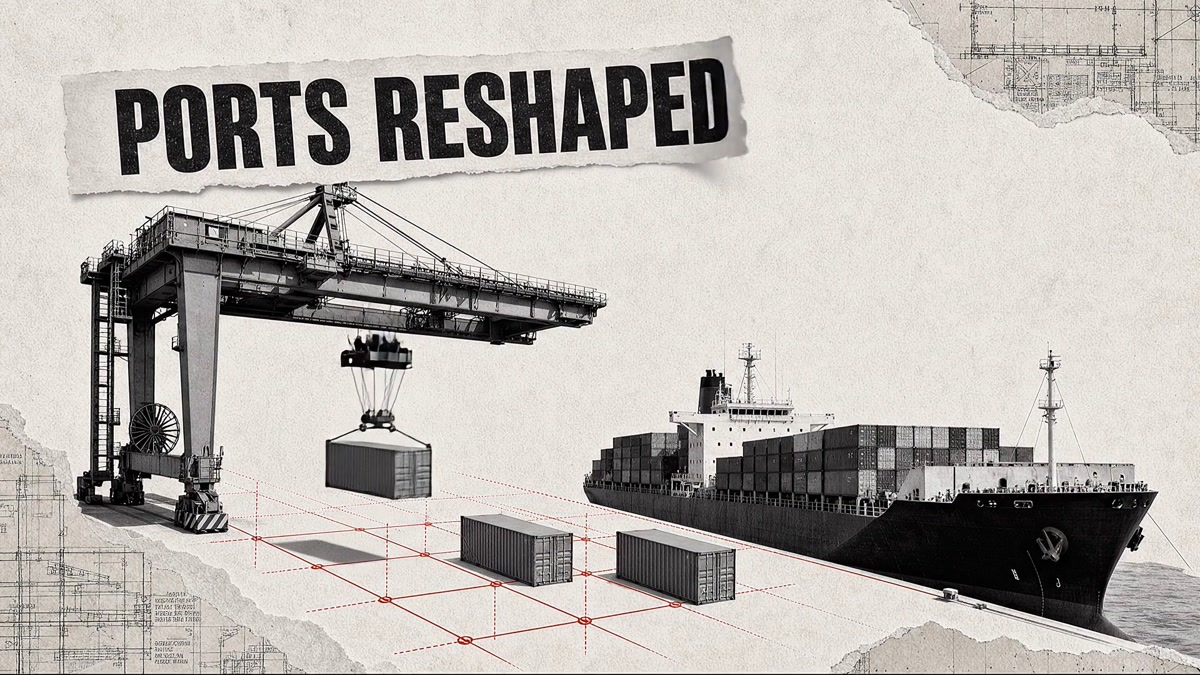
The geography of the port changed with the handling method. The Port Authority’s purpose-built Elizabeth terminal, opened in 1962, represented a port organized around large paved areas, highway access, specialized cranes, and continuous transfers of standardized units. Dense Manhattan piers had been built for break-bulk cargo, warehouses, and labor close to the water. Containerization rewarded open land and fast inland connections instead. The older waterfront did not need to disappear to lose its role; it only had to match the wrong interface.
This is why changing a container width is not comparable to changing the dimensions of an ordinary package. The number is repeated in physical capital across many owners. No single company controls enough of the route to replace it alone, and no participant wants to move first if the next terminal cannot receive the new geometry.
Why wider pallet-wide containers have not replaced it
The eight-foot standard is not proof that no other geometry can use interior space better. The European Pallet Association specifies a common pallet footprint of 800 by 1,200 millimetres. Carriers including CMA CGM document pallet-wide containers designed to accommodate that footprint more efficiently than a standard-width box in some loading patterns.
But a wider container arrives with a compatibility bill. It may need different positions on a ship, different lifting or terminal arrangements, and different plans for the road and rail legs. The cargo owner sees extra usable floor area; the network sees a second interface that must be recognized, routed, and sometimes isolated. A local efficiency gain can be real without being large enough to finance a global conversion.
Eight feet therefore survives as a coordination result. The standard does not have to defeat every alternative in a fresh design competition. It only has to remain cheaper to use than the combined cost and risk of moving everyone to something else. The better box, if there is one, must also bring a credible path for changing the world around it.
Questions behind the number
Were shipping containers always standardized at eight feet wide?
No. Early container systems were not fully interchangeable, and operators used competing dimensions, especially for length. The modern eight-foot width matters because it became part of an international interface, not because every earlier box already matched it.
What does ISO 668 cover?
ISO 668 classifies Series 1 freight containers and specifies external dimensions, ratings, and certain minimum internal and door-opening dimensions. Related standards cover other parts of the interface, including testing and corner fittings.
Are pallet-wide containers more efficient?
They can use the European pallet footprint more efficiently in some loading patterns. That does not make them universally better: compatibility with ships, lifting equipment, terminals, road transport, and rail transport still determines where they can be used economically.
Could the standard width ever change?
Technically, yes. Economically, a replacement would need coordinated adoption across many independent parts of the transport network. A new width must provide enough benefit to pay for both the new boxes and the equipment and operating changes around them.
Sources
-
International Organization for Standardization. ISO 668:2020 — Series 1 freight containers: Classification, dimensions and ratings.
-
Michael R. Harrison; Historic American Engineering Record and U.S. Maritime Administration. American Racer, HAER No. CA-346.
-
National Museum of American History, Smithsonian Institution. Transforming the Waterfront.
-
Roz Hamlett; Port Authority of New York and New Jersey. Port Newark: How Malcom McLean Changed the World.
-
Roz Hamlett; Port Authority of New York and New Jersey. The World in a Box: The Story Behind Modern Shipping.
-
U.S. Maritime Administration. East Coast Marine Highway Initiative: M-95 Corridor Study Final Report.
-
European Pallet Association e.V. EPAL Euro Pallet (EPAL 1): Specifications.
-
CMA CGM Group. Containers: Technical Specifications.